Business growth seldom halts abruptly; most companies don’t collapse overnight. Instead, they hit a wall – a plateau where momentum fades. 

Revenue stagnates, sales efforts intensify but returns diminish, and leadership teams feel busy yet progress slows.

If you’re questioning why business growth stalls, the answer is often internal. While market conditions play a part, research shows most plateaus stem from organisational structure rather than external forces. Recognising the true causes is the first step to overcoming them. 

Warning Signs of Growth Stalls 

Before revenue drops, early warning signs emerge:

  • Flatlining sales despite more activity
  • High effort with low conversion
  • Leadership bottlenecks
  • Reactive, short-term decisions
  • Operational silos
  • Poor cash flow visibility
  • Teams working hard but not aligned

These symptoms suggest structural issues, not just market slowdown.

Many businesses blame demand, competition, or pricing, but stalls are often rooted inside the organisation.

The 4 Structural Reasons Business Growth Stalls

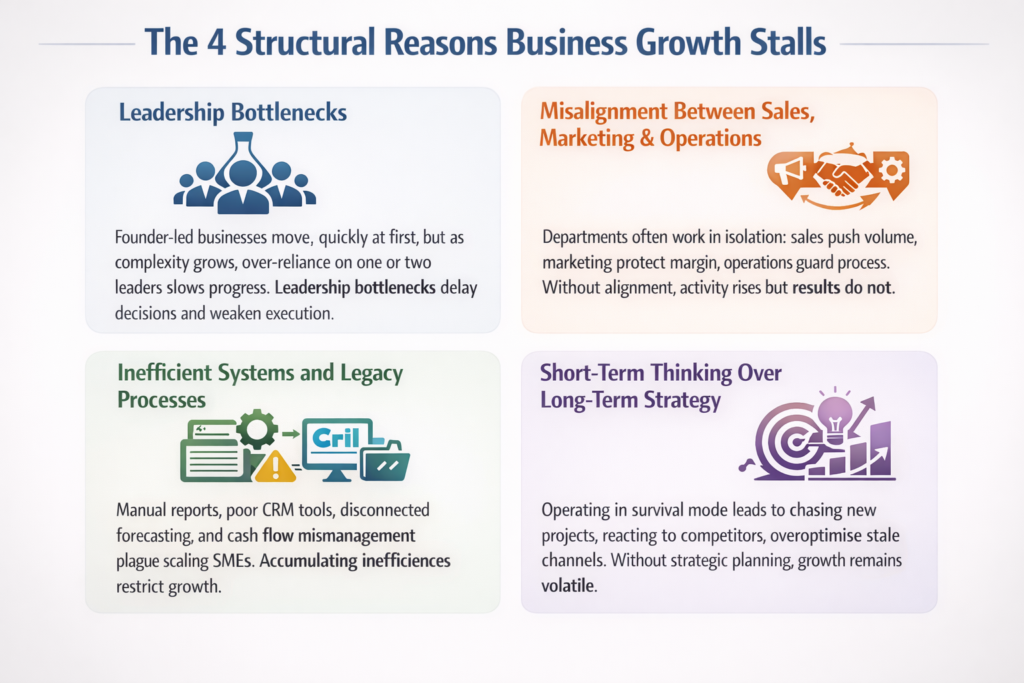
Leadership Bottlenecks 

Founder-led businesses move quickly at first, but as complexity grows, over-reliance on one or two leaders slows progress. Undefined accountability leads to reactive management, delayed decisions, and weakened execution. Structured leadership, not heroic effort, is essential.

Misalignment Between Sales, Marketing and Operations 

Departments often operate in isolation: sales push volume, marketing protect lead generation, operations guard process. Without commercial alignment, growth becomes inconsistent. Many SMEs lack pipeline engineering, qualification frameworks, and long-term revenue modelling. Activity rises, but results do not.

Inefficient Systems and Legacy Processes

Scaling companies outgrow processes designed for smaller turnover. Issues include manual reporting, poor CRM integration, unused AI tools, disconnected forecasting, inconsistent onboarding, and cash flow mismanagement. Such inefficiencies accumulate, restricting growth.

Short-Term Thinking Over Long-Term Strategy 

Operating in survival mode leads to chasing new projects, reacting to competitors, launching unmodelled products, and over-optimising stale channels. Without strategic planning, growth remains volatile. Sustainable companies build structured roadmaps, not just activity plans.

Why Business Growth Stalls – The 4 Structural Reasons Business Growth Stalls

Is this your business? get your free 100-day plan - one 20 minute call!

Why External Strategy Alone Doesn’t Work 

When growth plateaus, businesses often invest externally – marketing spend, new sales hires, technology platforms. But if internal alignment is broken, these investments underperform. No strategy fixes poor execution, and no tool resolves leadership misalignment. Internal structure must be corrected before expanding outward.

How to Fix Growth Plateaus

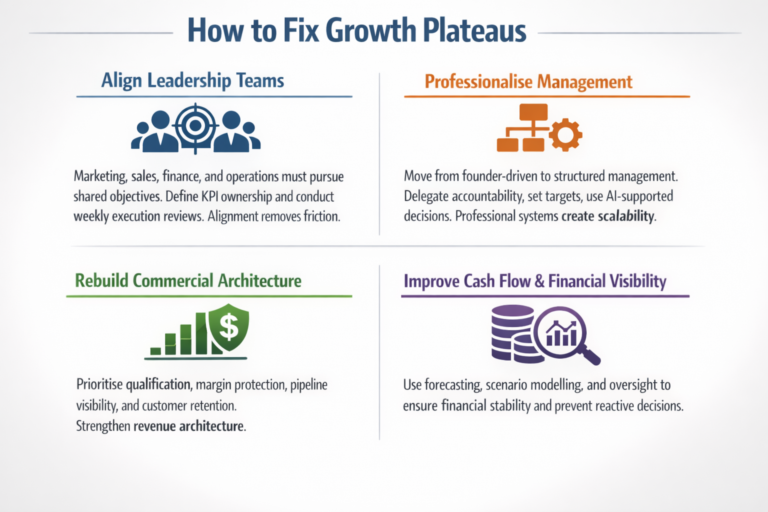
Align Leadership Teams 

Marketing, sales, finance, and operations must pursue shared objectives. Define KPI ownership and conduct weekly execution reviews. Alignment removes friction. 

Read more about ‘commercial strategy for SMEs“.

Professionalise Management 

Move from founder-driven to structured management: delegate accountability, set commercial targets, establish clear reporting dashboards, and use AI-supported decision-making. Professional systems create scalability.

Rebuild Commercial Architecture 

Prioritise qualification quality, margin protection, pipeline visibility, long-term contract structure, and customer retention. Strengthening revenue architecture accelerates growth.

Improve Cash Flow and Financial Visibility 

Even profitable businesses falter without stable cash flow. Use forward forecasting, scenario modelling, and commercial oversight to prevent reactive financial decisions. Growth requires financial stability.

Read more about ‘lead generation consultancy’.


Why Business Growth Stalls and How to Fix It

Case Study 1:

CBS360 Embeds to Drive Commercial Discipline

A mid-sized UK SME had strong products and loyal customers but revenue had flatlined for 18 months:

  • Cash flow was inconsistent,
  • sales and operations blamed each other
  • leadership meetings lacked clear commercial direction.


CBS360 integrated into weekly leadership meetings, rebuilt commercial forecasting, introduced structured reporting, clarified accountability, and implemented a 100-day activation plan.

Within 12 months, the business achieved:

£7.5 million in cost savings, margin control improved, revenue returned to controlled growth, and a long-term roadmap was established.

Case Study 2:

Manufacturing Firm Breaks Silo Barriers

A manufacturing firm struggled with operational silos:

  • marketing, sales, and operations worked in isolation.
  • Despite increased activity, conversion rates dropped
  • Cash flow was unpredictable.
  • Leadership was reactive, focusing on firefighting.


By aligning departments around shared revenue goals, implementing cross-functional dashboards, and introducing structured weekly reviews, the company built a unified commercial architecture.

Within nine months, the business achieved:

An increase in conversion rates by 22%, cash flow stabilised, and the leadership team shifted from reactive to strategic planning.

Case Study 3:

Tech Consultancy Transitions to Structured Management

A tech consultancy faced stalled growth after rapid initial expansion:

  • Processes remained manual,
  • Reporting was inconsistent,
  • Leadership was overwhelmed.


The solution involved delegating accountability, implementing automated CRM and reporting tools, and establishing clear commercial targets.

AI-supported decision-making improved forecasting and scenario planning.

Over the next 18 months, the firm reduced operational costs by 15%, improved client retention, and achieved sustained, scalable growth.

The Difference Between Coaching and Commercial Integration 

Business coaching inspires mindset improvement. However, growth stalls are rarely mindset problems – they are structural. Mindset sparks change; structure sustains it. SMEs facing plateaus need commercial integration: leadership alignment, disciplined execution, and revenue modelling.

Final Thought: Growth Stalls Are Turning Points 

Growth stalls are not signs of failure, but signals for evolution. They indicate the need to transition from reactive execution to structured commercial leadership. Businesses that address this early outperform competitors in volatile markets; those that ignore it risk decline. If your business has hit a wall, the solution isn’t more effort, but better structure.

Explore how embedded commercial leadership can restore momentum and drive sustainable scale. Book your growth call today.

If growth has stalled, the 100 Day Plan gives you clarity in one session!

Frequently Asked Questions

What are the 4 business growth strategies?

Market penetration, market development, product development, and diversification – each demands structured execution and commercial alignment for sustainable success.

The 1% rule means consistently improving systems or performance by 1%. Over time, these incremental gains compound, enhancing efficiency, revenue, and profit.

Startup, survival, stability, growth, expansion, maturity, and renewal or exit. Most companies stall between stability and growth due to structural barriers.

Most fail due to poor cash flow management and weak long-term planning, often compounded by misaligned leadership and inability to adapt to change.

Leave a Reply

Your email address will not be published. Required fields are marked *